

The Youth Alliance Against Central Taiwan Science Park and the Taiwan Rural Front yesterday called on the government to suspend construction of the Central Taiwan Science Park’s (CTSP) fourth-phase campus in Erlin Township (二林), Changhua County, as many of the country’s science parks still have a high percentage of idle space amid an apparent downturn in the high-tech industry.
“I don’t see the need to build more useless, idle science parks that do no good but waste taxpayers’ money and cause damage to the ecology and traditional local industries such as agriculture,” a member of the alliance, Chen Tzu-hui (陳慈慧), told a news conference held at the Legislative Yuan.
Citing government statistics, Chen said that in central Taiwan alone there are 1,466.46 hectares of idle land in the region’s science parks, including 83.97 percent idle space in Tongluo Science Park in Miaoli County, 40 percent in the CTSP’s first-phase campus in Greater Taichung and 47.43 percent at its second-phase campus in Yunlin County.
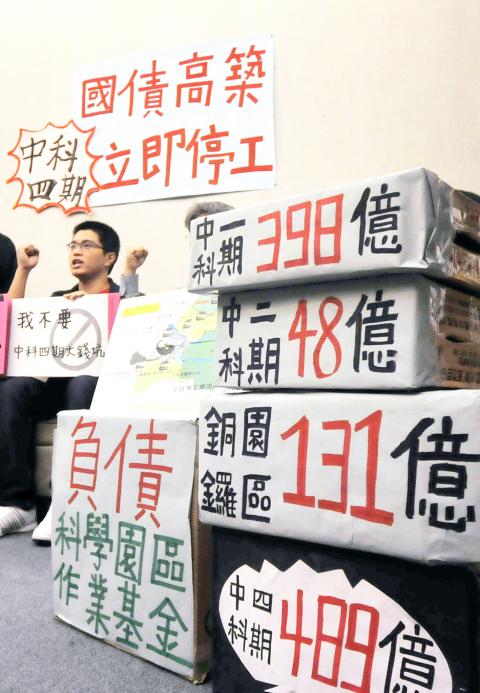
Photo: CNA
“On the construction of these science parks, the government has wasted hundreds of billions in taxpayers’ money; it must be stopped now,” she said.
Another member of the alliance, Lin Le-xin (林樂昕), said the Erlin campus project began when AU Optronics (AUO) asked for the government’s help to build a new plant, but “now that recession has hit the LCD industry, AUO announced [in September] that it would suspend all its expansion plans. Do we still need the Erlin campus?”
According to official estimates, NT$39.5 billion (US$1.2 billion) more is still needed to complete the Erlin project.
Citing information from the CTSP’s Web site, Lin said only two companies — one that manufactures medical accessories and another that produces mechanical parts — have expressed interest in building new factories in the 631 hectare Erlin campus.
“Doesn’t this phenomenon show that we already have more science parks than the demand for them?” he asked.
“In 2005, all science parks were NT$67.2 billion in debt, by the end of last year, they were NT$120 billion in debt,” Taiwan Rural Front spokeswoman Tsai Pei-hui (蔡培慧) said, quoting statistics from the National Audit Office.
“We should not create any more bottomless pits that swallow up taxpayers’ money,” Tsai added.
Yao Liang-yi (姚量議), a Taiwan Rural Front member who just graduated from National Kaohsiung Normal University’s Graduate Institute of Geography, said he grew up in a farming village and plans to go back home to make a living off agriculture after he completes his military service.
“No more farmland should be sacrificed for science parks and we don’t want to shoulder more government debt,” Yao said.
The Erlin project has also drawn opposition from farmers and environmentalists over water allocation and land expropriation issues.
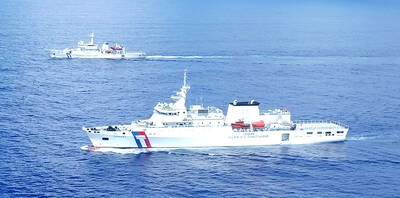
‘FRIENDSHIP FLEET’: A CGA official is scheduled to meet with the president of the Pacific nation, while one of the ships is to host a banquet and National Day event Two Coast Guard Administration (CGA) patrol vessels have docked at Malakal Harbor in Palau as part of an expedition exercise and diplomatic visit, during which a senior official is expected to meet with Palauan President Surangel Whipps Jr, the agency said yesterday. The two vessels, the 4,000-tonne-class Chiayi and the 1,000-tonne-class Penghu, set sail for Palau from Taiwan last week and arrived on Tuesday at Malakal Harbor, the CGA’s Fleet Branch said in a statement. The journey marks the second time the CGA has dispatched a “friendship fleet” to another country, after it sent its first-ever goodwill fleet, comprising the Hualien and
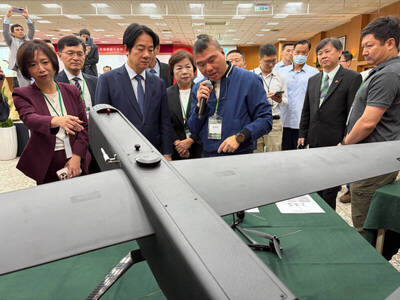
Two executives of drone supplier Jiin Ming Industry Co (錦明實業) have been detained and held incommunicado over the company's alleged use of prohibited China-made chips and camera lenses in drones supplied under recent military contracts, the Taoyuan District Prosecutors' Office said today. In a statement, prosecutors said they raided the offices of Jiin Ming — headquartered in Taoyuan — as well as those of its subsidiaries and its suppliers on Thursday last week. The raids followed a report that the company had breached its procurement contracts by putting the prohibited components into drones delivered to the military. During the raids, prosecutors summoned
The Coast Guard Administration (CGA) today said that two of its patrol vessels have docked at Palau's Malakal Harbor as part of an expedition exercise and diplomatic visit, during which a senior official is expected to meet with the Palauan president. The two vessels, the 4,000-tonne-class Chiayi (嘉義) and the 1,000-tonne-class Penghu (澎湖), set sail for Palau from Taiwan last week and arrived at Malakal Harbor yesterday, the CGA's Fleet Branch said in a statement. The journey marked the second time the CGA has dispatched a "Friendship Fleet" to another country, after it sent its first-ever goodwill fleet, comprising the Hualien (花蓮)
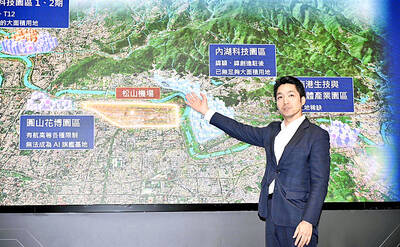
DETAILED PLAN NEEDED: Relocating the airport would affect not just travelers, but also undermine national defense and emergency medical services, a legislator said Taipei Mayor Chiang Wan-an (蔣萬安) yesterday proposed relocating Taipei International Airport (Songshan airport) and turning the site into an artificial intelligence (AI) park, drawing opposition from politicians across party lines. Chiang’s plan would turn the 300 hectares into an AI park featuring tech clusters, residential communities and green space. The industrial cluster would host 200 domestic enterprises, generate NT$12 trillion (US$376.47 billion) in output, and accommodate 65,000 jobs and 35,000 residents, he said. Cabinet spokeswoman Michelle Lee (李慧芝) said the Executive Yuan was surprised by the announcement, as the Taipei City Government did not discuss the proposal with the central government before making


 RSS
RSS